
The Self-Belief
Robert Frost, AI, the Bears, and Alex Bregman

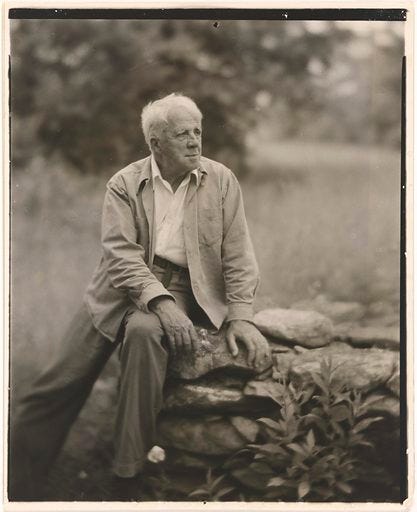
In 1931, Robert Frost gave a talk to a group of students at Amherst College that became known as “Education by Poetry.” The whole thing is worth a careful read, but I have been thinking about the end of the talk, when Frost shares the four beliefs that he believed all people shared. One of those is what he called the “self-belief.” Frost defined that as “a knowledge that you don’t want to tell other people about because you cannot prove that you know. You are saying nothing about it till you see.”
There’s a lot to parse through in that idea, but one aspect of it that has resonated with me lately is the notion of trusting in one’s ability, even when it remains unproven or undemonstrated.
Forgive me for straying from baseball for a bit here, but like a lot of people in Chicago, I was captured by this Bears team this season. I’m biased in my fandom, but I think it’s objectively true that they were the most exciting team to watch all year. They won games in the final minutes seven times — something that doesn’t happen without a healthy amount of self-belief. Something was instilled in that group early on that manifested in last-second touchdowns, overtime wins, and unlikely comebacks.
Looking ahead, the Cubs signed Alex Bregman to play third base, but if you read any of the analysis about what his impact on the team will be, the expectation is that it will extend beyond his stats to something intangible. He might imbue the team with a Bears-like self-belief.
I think healthy self-belief is important even in the microcosm. I’m still working on figuring out how to turn it off, but after a recent update, my Gmail app includes summaries of emails I receive and offers to “help” me write ones that I send.
There’s no bar for this either; this week I got a one-sentence email from a family member updating me about something simple that Gmail offered to summarize for me. I sent back a one-word response that Gmail offered to help me write.
I don’t need this. You don’t need this. No one needs this.
One thing that irks me about AI is the suggestion that it’s necessary for doing things that we are fully capable of doing ourselves. It’s an insult to our intelligence and ability. We have to be careful not to get dazzled by the parlor tricks and recognize the danger. (Like this or this, for example). Anything that makes you doubt that self-belief should be kept at a distance. Anything that distorts your sense of reality should be handled very, very carefully.
In 2023, Jaron Lanier said that his greatest fear was not that AI would take us over, but that it would break down our shared sense of reality to such an extent that we’d die of insanity. Unable to know or trust what’s real, there’s nothing to ground people. I think we’re perilously close to that point already.
“…the danger isn’t that a new alien entity will speak through our technology and take over and destroy us. To me the danger is that we’ll use our technology to become mutually unintelligible or to become insane if you like, in a way that we aren’t acting with enough understanding and self-interest to survive, and we die through insanity, essentially.”
It’s sort of like the Un-man in C.S. Lewis’ Perelandra, something that takes us further away from our intended existence by muddying our understanding of what’s real. And that shatters our self-belief. It’s happened with other forms of technology already; I still use the maps app to drive places I know full well how to get to because I’ve been somewhat conditioned not to trust my memory.
I’m not looking to throw out all the extremely useful aspects of modern technological developments, but at the same time I fear that our now decades-old approach of reflexively adopting any new advancement simply because it’s new is the wrong way to do things. I have wondered often these past few years if we’ve wandered too far, and a lot of that comes from a concern that we’re being told both explicitly and implicitly that we can’t and shouldn’t do things for ourselves that we very much should.
As Frost put it:
“A young man knows more about himself than he is able to prove to anyone. He has no knowledge that anybody else will accept as knowledge. In his foreknowledge he has something that is going to believe itself into fulfilment, into acceptance.”
By all means, delegate some tasks to AI, if you see fit. There are some valid uses, I suppose. But I say don’t let it encroach upon that self-belief, even down to the menial, like reading or writing an email yourself.
Things I’ve Done Lately:
I wrote about the Cubs and the 2026 luxury tax threshold. They haven’t paid the penalty in years, but they’re setting themselves up to be over the threshold this year.
On the impact of the White Sox (finally) trading Luis Robert, Jr. To their credit, I think they got a potentially exciting player in return.
The Cubs have beefed up their starting rotation, which should help solve a problem that hampered them last season.
What I’m Digging Right Now:
I just finished reading Saint Augustine’s Confessions, and there’s a lot about it that reminded me of Marcus Aurelius’ Meditations. Augustine’s book is a little longer, but I highly recommend it because of his brutally honest self-reflection on his journey to Christianity.
The Texas teacher who went full analog in her classroom. I’m all for it.
I’m looking forward to Martin Shaw’s new book that comes out next week.